
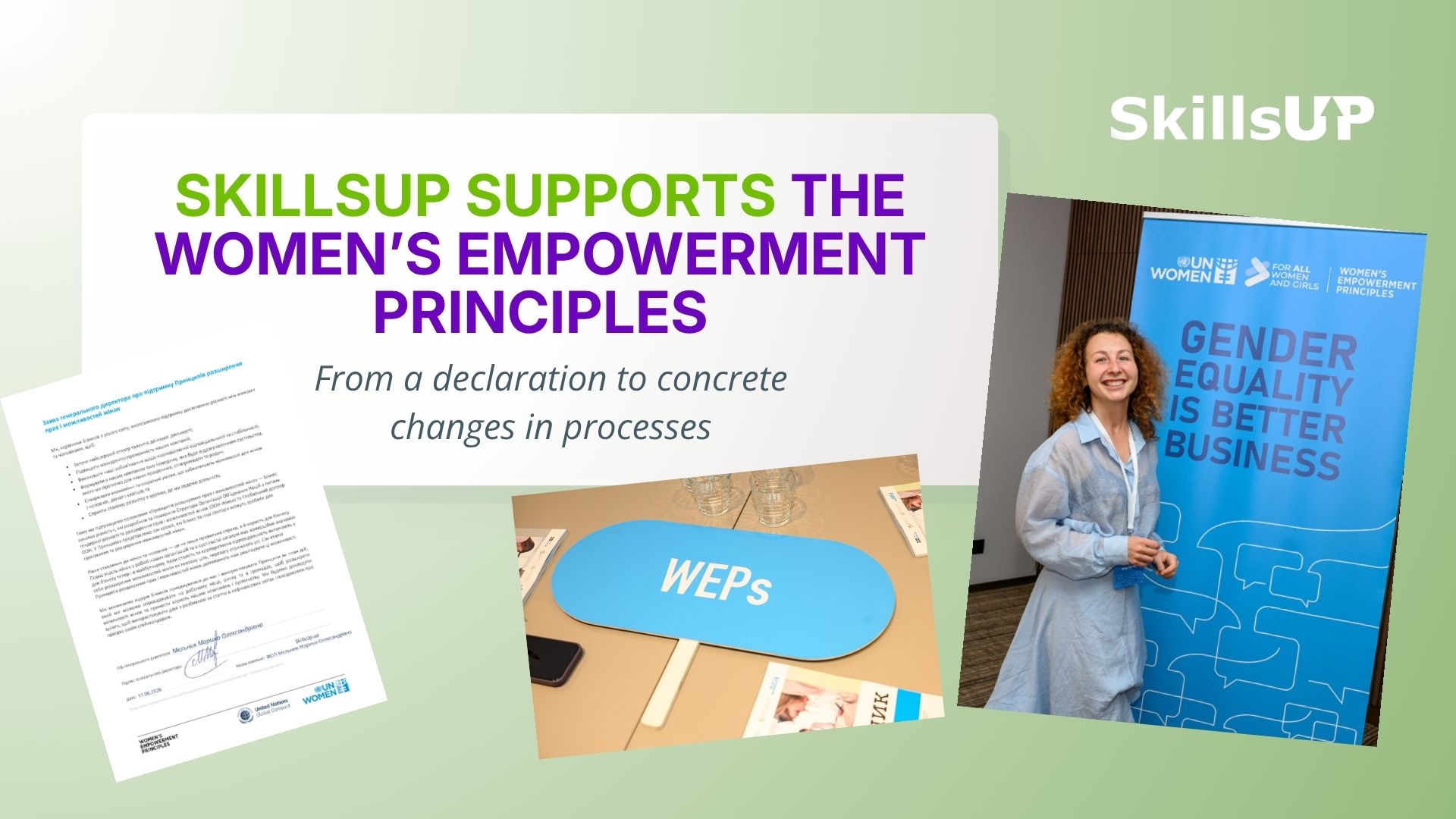
In June 2026, SkillsUp officially supported Women’s Empowerment Principles (WEPs) — the Women’s Empowerment Principles developed by UN Women and the UN Global Compact. CEO Statement of Support
On June 11, Marina Melnyk signed the CEO Statement of Support, confirming SkillsUp’s commitment to using WEPs as a framework for developing internal processes and engaging with its team, market, and communities.
Equality is not just a declaration of values. It is about concrete decisions in recruitment, team development, communication, marketing, and performance evaluation.
What are WEPs?
Women’s Empowerment Principles are seven principles that help businesses systematically work toward gender equality and expanding women’s economic opportunities.
For SkillsUp, this means not creating a separate initiative “for the sake of compliance,” but gradually integrating these principles into the company’s day-to-day processes.
7 WEPs Principles
- High-level corporate leadership
- Fair treatment of all women and men at work, without discrimination
- Health, well-being, and safety of employees
- Education and training for career advancement
- Business development, supply chains, and marketing practices
- Community initiatives and advocacy
- Measurement and reporting
From signing to practical change
After joining WEPs, a SkillsUp representative took part in a three-day training focused on the practical implementation of the principles in business.
The program covered not only a basic understanding of WEPs, but also specific issues that companies deal with every day:
| Area | What was covered |
|---|---|
| Recruitment and team management | equal treatment, non-discrimination, objective criteria |
| Corporate culture | gender-sensitive language, a safe working environment |
| Challenging situations within the team | responding to conflicts, inappropriate jokes, and harassment |
| Career development | equal access to learning and professional growth |
| Marketing | stereotypes in communication and advertising |
| Internal policies | how to translate declarations into specific documents and processes |
| Evaluation | metrics, self-assessment, and reporting |
Among the individual training sessions were “From Declarations to Documents: How to Implement WEPs Through Internal Company Policies,” working with challenging situations within the team, and gender representations in modern advertising.
One of SkillsUp’s practical steps — an internal Policy
As part of this approach, SkillsUp developed the Non-Discrimination, Equal Opportunity & Diversity Policy.
The document defines the company’s rules and standards across key processes — from recruitment to professional development and external communications.
What does the Policy cover?
Non-discrimination
Equal opportunities in recruitment
Equal access to development
Safe working environment
Responsible marketing
It’s not just about the Policy
WEPs are not simply about adopting a document.
A key focus of the program is measurement, self-assessment, and reporting, so that the company can see how its practices work not just on paper, but in real processes.
Therefore, the next step for SkillsUp is to gradually track internal indicators in the processes covered by the Policy: recruitment, team development, communication, and other areas.
This makes it possible to move from:
What does this mean for SkillsUp?
For us, participation in WEPs is a long-term process.
We are starting with internal rules and practices, gradually integrating them into the company’s work, and will continue to evaluate their effectiveness.
This is another step toward an environment where decisions are based on competencies, professional contribution, transparent criteria, and respect for every person.