
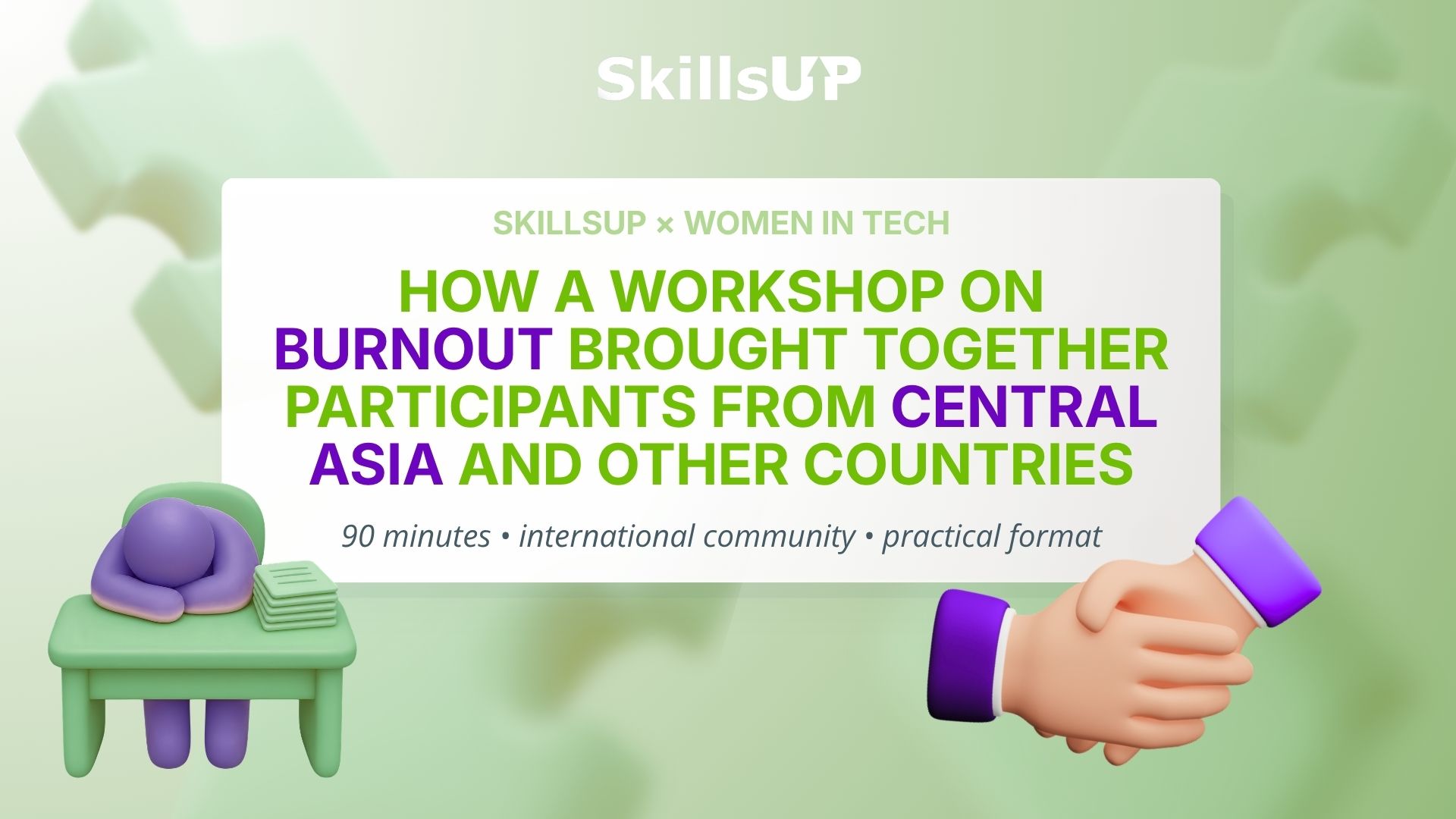
Topic: Burnout: How to Preserve Your Energy and Happiness
Duration: 1.5 hours
Expert: Marina Melnyk, SkillsUp
Audience: international Women in Tech community
This workshop became SkillsUp’s first collaboration focused on an audience from Central Asia — and at the same time an opportunity to test how our expertise works beyond the familiar Ukrainian context.
🌍 One Topic — Different Countries
Participants joined from Tashkent and Astana, as well as from the international community in Spain, Latvia, Estonia, Turkey, and other countries.
And although the geography was different, the questions turned out to be remarkably similar:
- How can I tell that I’m not simply tired?
- When is it time to stop?
- And what can I do before my resources run out completely?
That is why the focus of the session was not on how to recover from severe burnout, but on how to recognize it earlier. The organizers specifically wanted to help participants identify the warning signs before reaching a critical stage.
Not a Lecture About Burnout, but 1.5 Hours of Paying Attention to Yourself
At the beginning, Marina invited participants to put aside their work roles, tasks, and deadlines for a while and answer a simple question:
“How much energy do I have right now — honestly — from 0 to 10?”
This became the starting point for a short self-check. Participants reflected on:
- what was taking up most of their energy at the moment;
- what, on the contrary, helped them recover;
- when they last felt truly energized and fulfilled;
- whether ordinary rest actually helped them recover;
- which things they continued doing simply “on autopilot.”
This allowed the workshop to move immediately from general theory to the personal experience of each participant.
“I’m Tired” ≠ “I’m Burned Out”
One of the central parts of the session was understanding where this line lies.
A simple guideline participants took away with them:
- Fatigue → I rest → my energy returns
- Burnout → I rest → but my energy still doesn’t fully recover
If a person returns to work feeling energized after the weekend, most likely their body simply needed some rest.
But if one weekend passes, then another, and another, while exhaustion continues to accumulate — that is a signal to take a closer look at what is happening.
From the First Warning Signs to the Red Zone
During the workshop, Marina explored 12 stages of burnout — a gradual path from an excessive desire to get everything done and prove your effectiveness to serious exhaustion.
Particular attention was paid to the so-called “yellow zone.” It can manifest in ways that are not always obvious:
- not wanting to respond to messages;
- losing the desire to see other people;
- things that never used to bother you suddenly becoming irritating;
- feeling apathetic;
- finding it harder to concentrate;
- wanting to simply “hide from everyone.”
It is already an uncomfortable state, but it can still be addressed if you notice it in time.
This part particularly resonated with one of the participants:
What to Do With This Knowledge?
The workshop did not end with “here are the symptoms — keep an eye on yourself.” Participants received small practices that can be integrated into everyday life. For example:
- 01. Don’t automatically say “yes.” Even if your first reaction is to agree to a new task, give yourself time to check your current workload first.
- 02. 15–20 minutes just for yourself. No work, messages, or need to be productive.
- 03. Gratitude practice. For one week, at the end of each day, write down something you are grateful for.
- 04. Write a letter to your future self. Write a supportive message to the version of yourself who may find things difficult again one day.
- 05. Return to your own sources of energy. People, activities, walks, creativity, sports — whatever genuinely restores you.
These tools were discussed directly during the workshop as practices participants could start experimenting with after the session.
Without the Need to “Open Up” in Front of Everyone
The topic of burnout can easily lead to very personal stories. That is why participants’ comfort was one of the principles of the session.
- Didn’t want to answer out loud? You could simply keep the answer to yourself.
- Wanted to ask a question? The chat was available.
- Was the question too personal for the whole group? You could reach out privately to the expert or organizer.
You don’t have to share your story with everyone to start having an honest conversation about it with yourself.
90 Minutes — and Participants Stayed Until the End
For online events, this is one of the strongest indicators of engagement.
Participants who joined at the beginning of the workshop stayed until the end. After the session, the organizers planned to return to the recommendations, share materials, and send reminders in the chat.
Here is another piece of feedback from the session:
Why This Case Means More to SkillsUp Than Just One Workshop
This session became SkillsUp’s first practical point of contact with an audience from Central Asia. Tashkent. Astana. The international Women in Tech community. One topic that proved relevant regardless of the country.
For us, this is an important signal: SkillsUp’s expert content can work for a broader audience — provided we do more than simply translate materials and take into account the context of the people we create them for.
The Next Step
To develop this direction through:
- partnerships with local professional communities;
- adapted educational events;
- expert-led workshops;
- corporate learning formats;
- content for audiences across Central Asia.
More About Burnout
If this topic resonated with you, SkillsUp already has materials to help you explore it further — from early warning signs to systematic burnout prevention.
📖 Burnout Doesn’t Start With “I Can’t Do This Anymore”: How to Spot It Early
How to recognize the first warning signs, understand the stages of burnout, and avoid waiting until complete exhaustion.
Read the article →
📖 Ignoring Stress Is the Path to Burnout
How chronic stress accumulates, why we often ignore its warning signs, and what consequences this can lead to.
Read the article →