
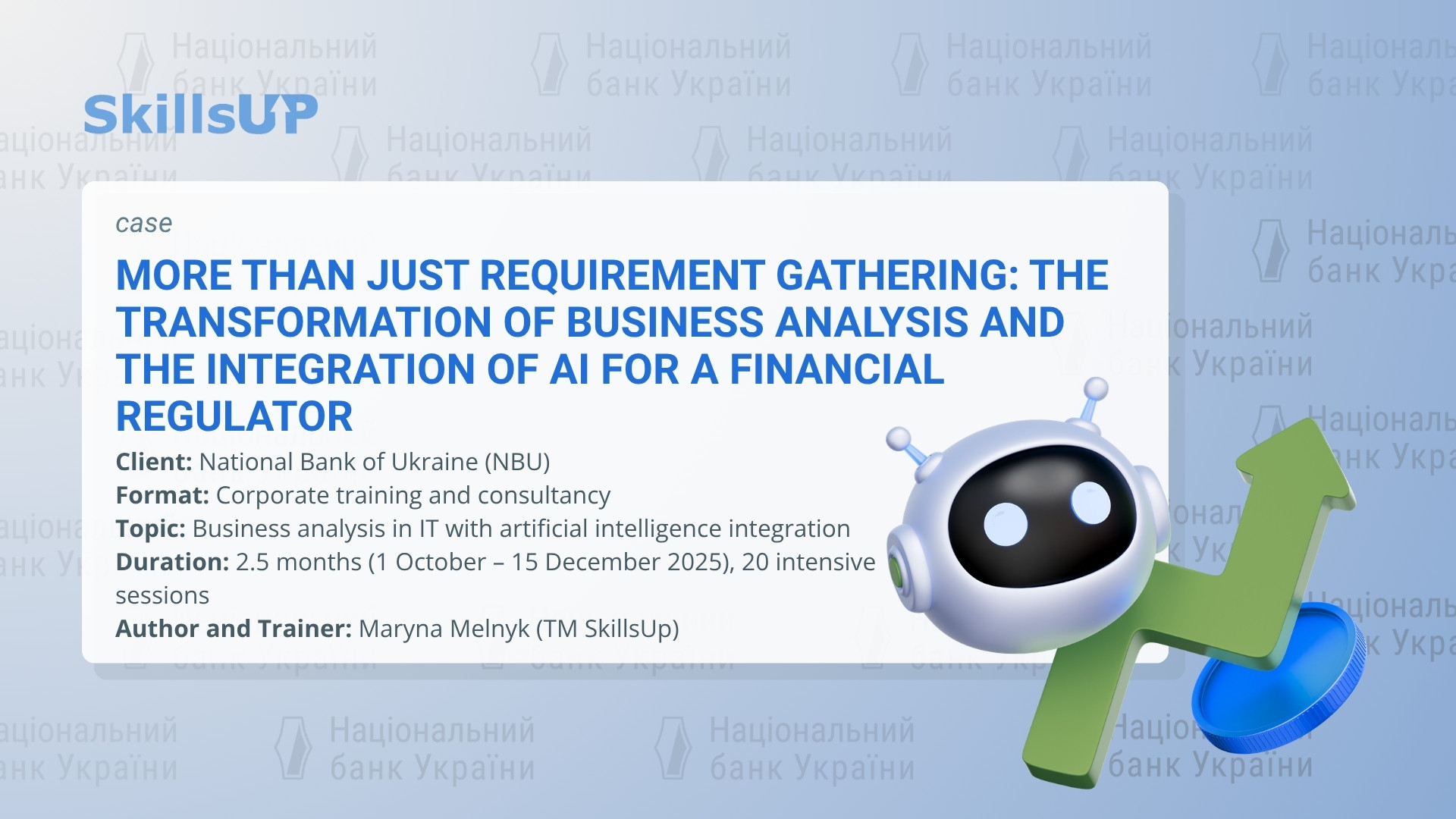
In the modern technological landscape, the financial sector demands not only flawless logic and security but also flexibility in implementing innovations. The National Bank of Ukraine (NBU), as the main financial regulator of the state, constantly improves its internal processes and enhances the qualifications of its teams. This case study describes a comprehensive consulting and training program designed specifically for NBU IT specialists, focusing on advanced business analysis (BA) practices and the integration of artificial intelligence (AI) tools into their daily work.
Project Passport
Client: National Bank of Ukraine (NBU)
Format: Corporate training and consulting
Topic: Business Analysis in IT with Artificial Intelligence Integration
Duration: 2.5 months (October 1 – December 15, 2025), 20 intensive sessions
Author and Trainer: Maryna Melnyk (TM SkillsUp)
Context and Prerequisites
The role of a business analyst in the modern IT environment has gone beyond simply gathering and documenting requirements. Today's analyst is a product visionary who ensures synergy between stakeholders, the technical team, and end-users.
For the National Bank of Ukraine, it was critically important to update the methodological base of its IT specialists, systematize knowledge in requirements management, and, most importantly, be the first in the public sector market to safely and effectively implement AI tools into analytical processes.
Key Program Objectives
- Knowledge systematization: Form a single, standardized approach to the Software Development Life Cycle (SDLC) and requirements engineering.
- Implementing product thinking: Train the team to think in terms of value (North Star metrics) rather than just functional characteristics.
- Technical integration: Deepen the understanding of architecture, databases, APIs, and interaction in a CI/CD environment.
- Innovative leap: Practically master prompt engineering and delegating routine tasks to AI (generating requirements, Use Cases, test scenarios).
Solution Architecture: Course Structure
Instead of standard academic lectures, the SkillsUp team, led by Maryna Melnyk, developed a deep, customized 20-step program. The training was divided into logical sprints, each accompanied by practical work using real tools (Jira, Confluence, Draw.io, Figma, ChatGPT, Claude).
Block 1: Foundation and Stakeholder Interaction (Sessions 1–5)
The program began with an audit of the current IT landscape and the business analyst's place in it. The participants analyzed industry standards, BA ethics, and built stakeholder matrices. A special emphasis was placed on the product approach — forming a product vision, identifying key success metrics, and building communication plans.
Block 2: Requirements Engineering and Process Modeling (Sessions 6–10)
The most intensive part of the course, dedicated to the hard skills of an analyst. The participants practiced the following:
- Creating a Product Backlog, decomposing User Stories, and writing Use Cases.
- Defining Definition of Ready (DoR) and Definition of Done (DoD) criteria using the INVEST principle.
- Change and risk management (creating risk matrices and change logs).
- Business process modeling in BPMN 2.0 notation and the basics of building UML activity diagrams.
- Prototyping (UI/UX) considering WCAG accessibility standards and Jakob Nielsen's heuristics.
Block 3: Artificial Intelligence as an Analyst's Partner (Sessions 11, 14, 16, 18)
The innovative core of the program. The NBU team learned to use LLM models as a powerful amplifier of their own expertise.
The workshop included writing effective prompts for generating functional and non-functional requirements, preparing for stakeholder interviews, and creating UI prototypes using AI. The participants analyzed exactly which routine tasks can be safely delegated to AI while maintaining control over quality and data confidentiality.
Block 4: Technical Orientation, QA, and Release Preparation (Sessions 12–13, 15, 17)
To speak the same language with developers, the analysts delved into technical aspects. They analyzed in detail the impact of BA on ensuring product quality (internal and external quality), creating test matrices using AI, and conducting User Acceptance Testing (UAT).
Block 5: Pitching and Finalization (Sessions 19–20)
The course concluded with the development of self-presentation and professional branding skills. The specialists learned to structure their own solutions, work with feedback, and use their strengths and weaknesses to create compelling presentations. The finale was the defense of their own projects.
Cooperation Results
Thanks to a comprehensive and deeply practical approach, the training brought tangible results for the NBU's IT department. A transformation in thinking occurred: from reactive task execution to proactive requirements management using the latest technologies.
"The services under the specified contract were provided properly, with high quality, and in full... Modern tools and presentation materials were used for quality training of employees. The program was well-structured, relevant, and useful for practical work."
Key project achievements:
- Process standardization. The team received a unified framework for identifying, documenting, and managing requirements.
- Time optimization. By integrating AI tools, the analysts significantly reduced the time spent preparing initial documentation and generating test data.
- Increased technical literacy. Communication between business analysts, QA engineers, and developers improved through a deeper understanding of architectural principles.
"Melnyk Maryna Oleksandrivna demonstrated a high level of professional expertise, competence, systems thinking, as well as the ability to clearly and understandably explain complex material. The learning atmosphere was friendly and motivating, which contributed to a better assimilation of the material."
This case study is a prime example of how top-level government institutions successfully invest in talent development and are the first to adopt innovations, such as artificial intelligence, to ensure uninterrupted and high-quality software development.