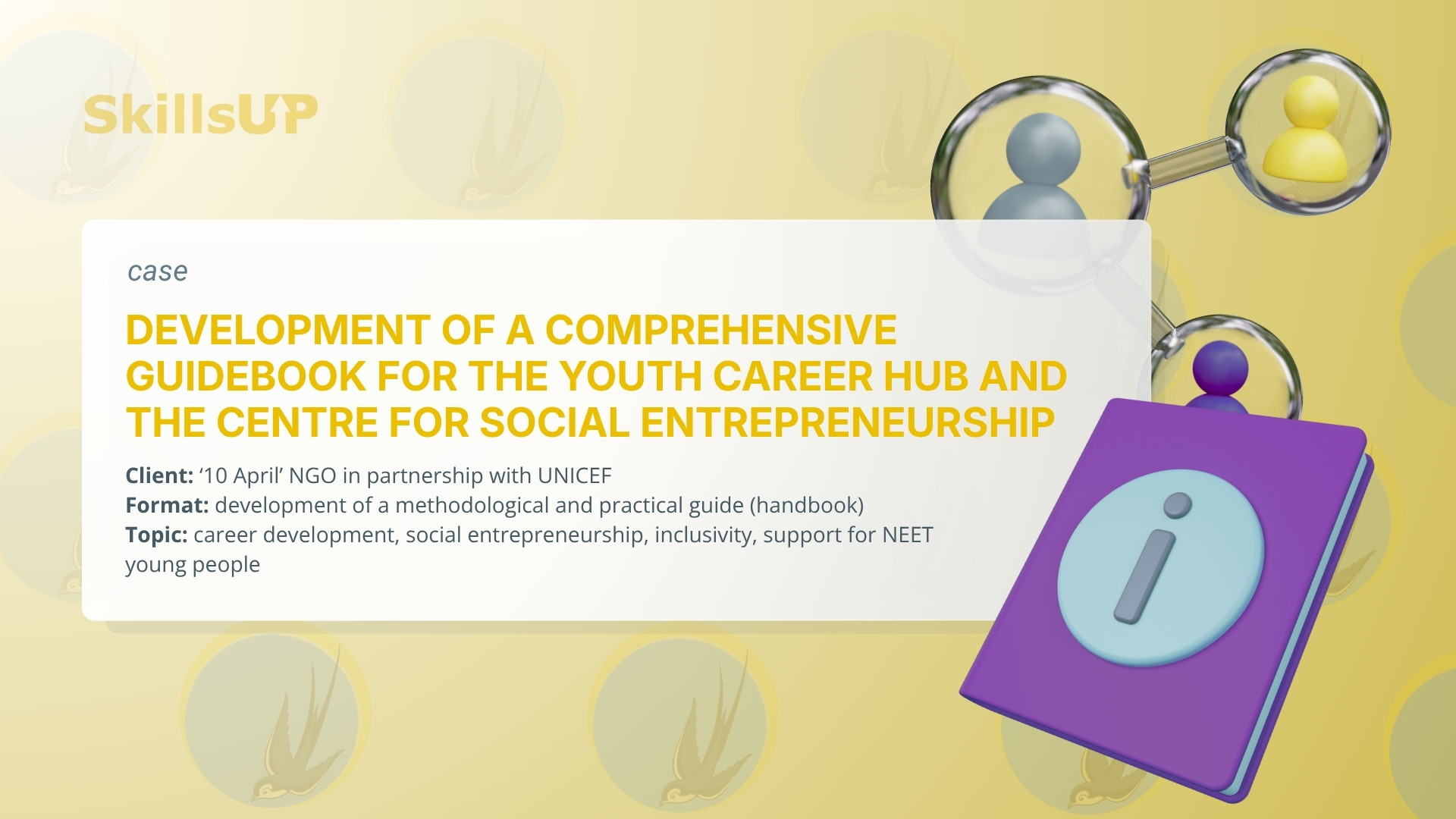
Client: NGO "The Tenth of April" in partnership with UNICEF
Format: Development of a methodological and practical manual (guidebook)
Theme: Career development, social entrepreneurship, inclusivity, support for NEET youth
Team: Experts and content creators at SkillsUp
Context
The southern regions of Ukraine (Mykolaiv, Odesa, and Kherson regions) are facing unprecedented challenges: economic instability, infrastructure destruction, mass migration, and a high level of social exclusion among youth. A significant portion of young people falls into the NEET (Not in Education, Employment, or Training) category—they do not study, do not work, and often lose motivation due to a lack of clear prospects.
In response to these challenges, the NGO "The Tenth of April", together with UNICEF, initiated the creation of career hubs and social entrepreneurship centers. However, for the effective launch and scaling of such spaces, the client needed a single standardized document that would turn scattered ideas into a clear, measurable, and reproducible system.
It was necessary to create not just a theoretical manual, but a practical tool written in an accessible language for both the youth themselves and the organizers.
Tasks
Our team faced the following key tasks:
- Create a guidebook highlighting the activities of the Social Entrepreneurship Center and the Career Center in Mykolaiv, aligning the project with the vision of the NGO "The Tenth of April" team.
- Describe the mission, structure, and strategic goals of the youth centers.
- Develop step-by-step operational models, functions, areas of youth support, as well as educational and mentoring programs.
- Cover the topics of career development, modern approaches to building a career (including self-employment and the gig economy), and the competencies required for success.
- Describe youth support tools, including grants, incubators, and hubs.
- Integrate a comprehensive section on inclusivity, social responsibility, and sustainability.
- Ensure the inclusion of practical tips, case studies, infographics, and document templates.
- Prepare the document in Ukrainian with a brief English summary.
Solution: Customized Guidebook Architecture
Instead of creating a set of dry bureaucratic instructions, our team developed a modular guidebook architecture. We structured a large volume of information into logical sections that are easy to read, visualize, and apply in practice.
Module 1. Context and Target Audience
We began with an in-depth analysis of the problem. The guidebook provides a detailed profile of the NEET audience, outlining their psychological barriers and key needs.
We also demonstrated the synergy between the career development track and social entrepreneurship, enabling young people not only to find employment but also to establish socially responsible businesses during the country's recovery.
Module 2. Space Model (Hub MVP)
We designed the physical and organizational structure of the hub.
The guidebook introduces dedicated functional areas, including information, career support, communication and gaming, and a social entrepreneurship workshop.
To facilitate rapid implementation, we developed a step-by-step roadmap for launching a Minimum Viable Product (MVP) of the hub within 60 days, including the minimum equipment requirements and team roles.
Module 3. Full Cycle of Youth Engagement
The most important stage was developing a structured participant engagement funnel.
The guidebook details every phase of the journey—from outreach activities (engaging young people through community work and social media) and information sessions to ideathons, hackathons, and long-term mentoring support.
Module 4. Educational Tracks and Gamification
The educational model consists of two parallel tracks:
- Career Track: Resume writing, interview preparation, soft skills development, and career guidance.
- Entrepreneurial Track: Business modeling, financial planning, zero-budget marketing, and legal fundamentals.
The methodology is based on the "learning by doing" approach and the 70–20–10 learning model, where most of the learning takes place through practical activities, simulations, and non-formal education.
Module 5. Practical Tools, Funding, and Inclusivity
To maximize practical value, we included a dedicated section on mini-grants, explaining how to attract, distribute, and manage funding.
We also developed a system of KPIs and performance metrics (NEET outreach rate, employment outcomes, number of launched initiatives) and added recommendations for building partnerships with local authorities, businesses, and donors.
Special attention was devoted to inclusive spaces and accessible programs for vulnerable groups.
Advantages of Our Approach
One of the biggest challenges of similar methodological materials is their complexity. Our strength was transforming complex ideas into clear, structured, and visually accessible information.
Two-Vector Communication (Tone of Voice)
We designed the guidebook to communicate simultaneously with two audiences.
For young people, it functions as a practical navigator and friendly guide, while for center managers and facilitators, it serves as a structured methodological framework.
Practicality over Theory
The guidebook avoids unnecessary theory.
Each module concludes with ready-to-use resources, including grant application templates, zoning schemes, workshop plans, real-life case studies (from coffee shops to 3D laboratories), and practical checklists.
Visual Orientation
The structure was designed to support infographics, diagrams, and visual process maps, such as the journey from an idea to a social enterprise.
This makes complex topics—including grant management and KPI systems—easy to understand and implement.
Results and Project Impact
The completed guidebook became a comprehensive operational framework for establishing youth centers across the region.
Systematization
The client received a standardized framework that transforms intuitive youth engagement into a measurable process with clearly defined stages and performance indicators.
Scalability
Thanks to detailed descriptions of the organizational model, Hub MVP, and funding mechanisms, the guidebook enables the NGO "The Tenth of April" and UNICEF to replicate similar centers not only in Mykolaiv but also in other de-occupied and war-affected communities.
Focus on Sustainability
The methodology emphasizes that success should be measured not by the number of events delivered, but by meaningful, long-term outcomes—from sustainable employment to the creation of successful social enterprises.